WORKBOOK STRUCTURE & CHOICE
A DCF model template organizes the path from operating assumptions to cash flow and value. A useful Excel workbook makes that path inspectable: the forecast drivers, linked financial statements, discount rate and terminal assumptions should be visible.
What the four worksheets do
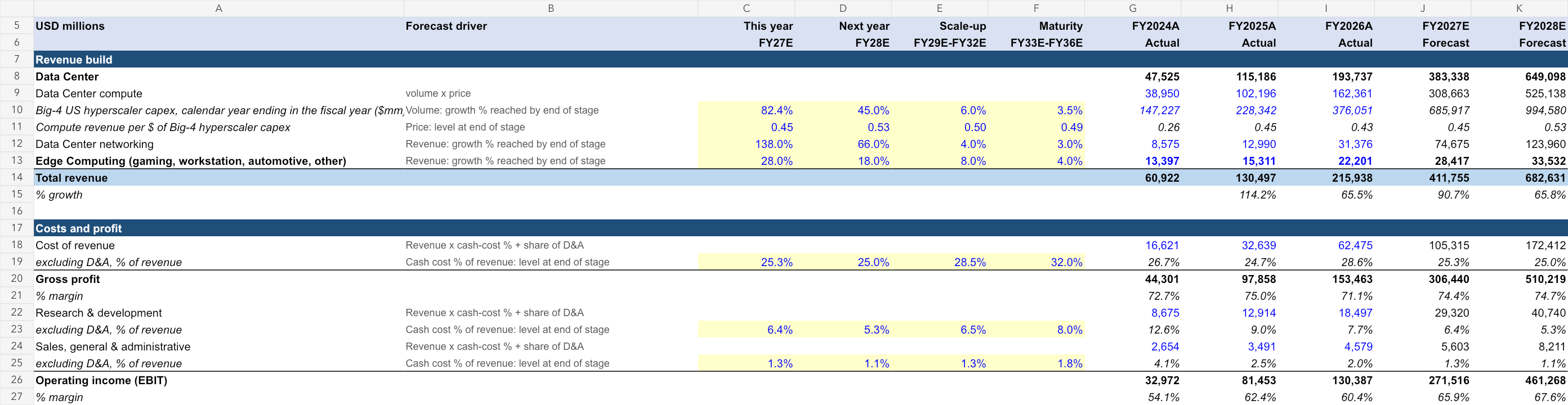
- Income Statement: connect the company’s revenue engine and cost assumptions to operating profit. A volume-times-price build helps distinguish demand from pricing.
- Balance Sheet: model assets, liabilities and working-capital needs consistently with the operating forecast.
- Cash Flow: follow reinvestment and noncash adjustments to see the cash generated by operations.
- DCF Valuation: discount the forecast cash flows and continuing value, then inspect valuation sensitivities.
How to use an editable DCF template
Start with the edition’s units, fiscal-year labels and source notes. Blue values are hardcoded; yellow cells highlight editable assumptions; green formulas connect sheets and black formulas calculate results. Keep an unchanged copy so you can distinguish your edits from the author’s base case.
Change a small set of operating assumptions first, then follow the effect through cash flow and value. Check that working capital and capital expenditure support the forecast, and that the terminal cash flow reflects a sustainable operating state. A workbook can organize the arithmetic; it cannot verify every assumption for you.
Free versus company-specific Excel models
| Feature | Free Excel | One company | Full catalog |
|---|---|---|---|
| Price | $0 · Email confirmation | $19.99 paid once | $59.99 paid once |
| Scope | Simplified SpaceX workbook | One company’s model | All 17 models; new additions during your year |
| Forecast approach | One revenue growth rate and flat ratios | Company-specific operating drivers | Company-specific operating drivers |
| Modeled periods | Five | Ten in current editions | Ten in current editions |
| Worksheets | Four linked tabs | Four linked tabs | Four linked tabs per model |
| Updates and downloads | Learning download; no paid update promise | 12 months for that company | 12 months across the catalog |
| Automatic renewal | No payment | None | None |
Paid files you download remain usable after access expires. No fixed update cadence is promised. Purchase terms explain the single-user license, refunds and delivery. Checkout remains disabled until payment and protected delivery tests pass.
A quick calculation or a full operating forecast?
The manual DCF calculator discounts cash flows you already have. It does not build financial statements or fetch company data. Use the free five-year workbook to learn the linked statements, or choose a company model when you want the supplied operating-driver framework and its dated source annotations.
Common template mistakes
- Mixing currency amounts with a different scale for the share count.
- Treating a forecast assumption as a reported historical fact.
- Discounting equity cash flow at WACC instead of matching the cash flow and discount rate.
- Using terminal growth at or above the discount rate.
- Expecting a spreadsheet’s base case to be a guaranteed investment outcome.
For the valuation method and a fictional numerical example, follow the step-by-step DCF valuation guide. For a supplied company example, read the NVIDIA edition’s driver and source notes.